Supplier sources are the sole authority for what the provider documents.
Anything a source does not state is left as null and recorded in missing — never inferred, never filled in with REST/OAuth conventions.
When validation hits something missing, it fails loudly rather than using guesses to make the docs "look complete." Every design decision in this project exists to hold this line.
Nor does a supplementary source weaken it. A hand-written excerpt of supplier correspondence may fill missing, but it is not a formal document: the formal document wins any disagreement, the excerpt never reaches explicit_support, and every claim resting only on it is named individually (ADR 0010).
Passive Implementation Observations do not weaken this rule. They report empirical behavior only inside an exact Applicability Envelope and use a separate confirms / contradicts / inconclusive / out_of_scope axis; none of those outcomes becomes supplier-source support.
The converse also has to be evidenced: "the source does not state it" is a claim that must be earned. source_facts/ mechanically scans Markdown sources for parameter tables and example blocks, and blocks the run when a source plainly documents them but the extraction came back empty; placeholder answers such as "requires further extraction" are blocked the same way. To claim a field genuinely is not in the source, name it in missing — so this gate only ever forces a named gap, never a fabrication.
Be clear about its limits, though: the scan only recognises well-structured Markdown (headings, GFM tables, fenced blocks). If a source is flattened into long single lines it yields zero facts and the gate does nothing. A clean gate exit does not mean the extraction is complete — it catches omissions that can be mechanically proven; everything else still needs human review.
Better to flag "missing" than to fabricate contentFour closed loops: source, quality, version, handoff
loop-apidoc's engineering focus is to make source, quality, version, and handoff all machine-reproducible, human-verifiable, and pickup-ready for downstream users — not just to produce a document.
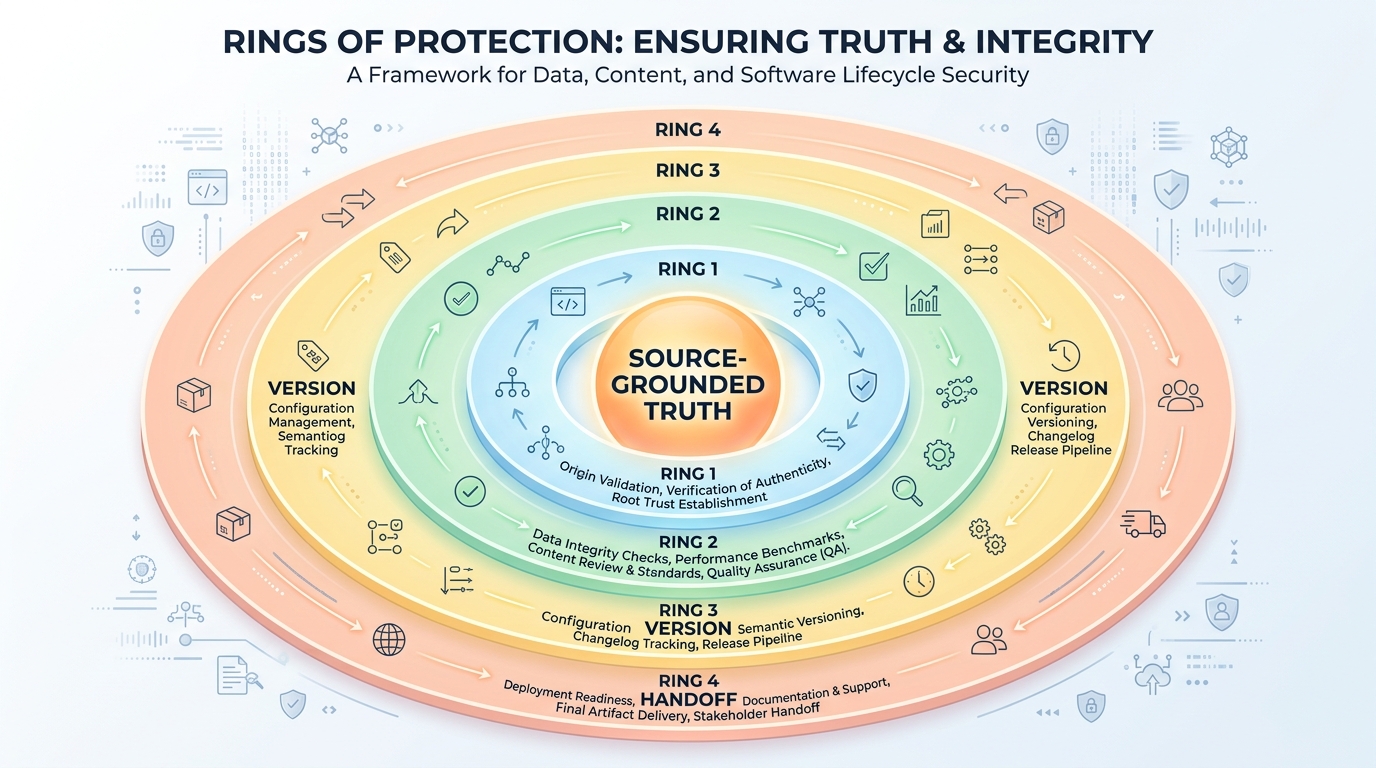
Source-grounded loop
sources → extraction → provenanceEvery output must trace back to a source citation; information a source doesn't state is left as missing, not filled in by convention.
Quality loop
preparation · validate · scorepreparation flags governance items that need attention before generation, validation blocks errors, and score turns the finished product into a comparable quality signal.
Version loop
run-dir → diff/reportTwo runs can be classified into breaking/additive/changed/source_only, giving version updates a downstream-impact reading.
Handoff loop
integration-contract · examples · handoff/OpenAPI and the always-written integration contract are the machine contracts; the latter preserves typed transport, amount-direction, idempotency, line-currency, and cross-endpoint operational rules, while the derived Postman collection, SDK hints, task list, and examples help the next engineer pick it up.
Feedback can improve an exact-scope operational view without rewriting provider documentation
The feedback command group assesses passive normalized observations, proposes and persists review cases, requires independent human approval for expiring amendments, and resolves an exact-scope Effective Contract. Assessment and preview perform no network I/O and write outside .foundry; only explicit submit/review/approve steps mutate governed state.
Normative Contract
supplier-source authorityThe immutable approved account of what the provider documents. Global Foundry current always points to this axis.
Implementation Observation
empirical · exact envelopeSanitized, digest-bound behavior evidence with producer, runner, replay, attempts, time, environment, region, identity, and configuration scope.
Compatibility Amendment
reviewed · expiring · scopedA reproducible safe difference may be proposed, but an independent human approves it. Its proposal binds the complete Normative release digest: contract, documentary fragments, and support relationships.
Effective Contract
deterministic compositionOne normative release plus applicable active amendments for one exact target. Composition rechecks the full release digest; each value retains normative or observed-override authority and lineage.
Two stages: agent extraction ‖ deterministic CLI back half
This is the mental model you most need to build first. The whole pipeline is split in two, with two JSON files as the only boundary in between; each side can be tested and swapped independently.
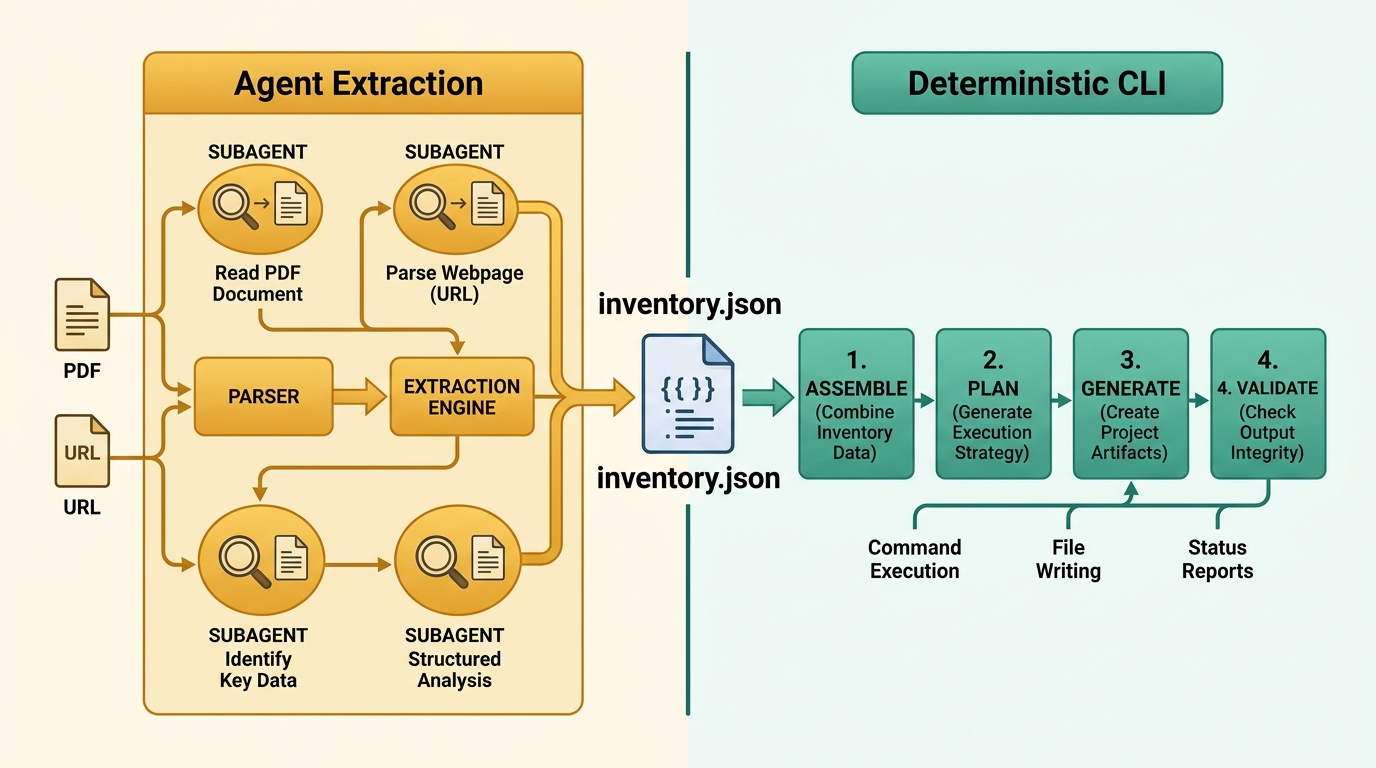
agent extraction (Claude Code / Codex)
- Pre-agent risk gate: after preprocessing and manifest creation,
inspect-source-riskmust pass before any agent reads source content. - Read-only subagent fan-out: the main agent dispatches multiple subagents, each of which only reads files / searches / fetches URLs and returns structured JSON, never writing files.
- The main agent consolidates the returned JSON and writes it into the seam files.
- Extraction is staged per
SKILL.md(see the ten stages below), ensuring only what the sources actually state gets recorded.
inventory.json
endpoints/*.json
assemble (deterministic CLI)
- Does not extract; it only assembles the JSON the agent wrote.
- Runs
manifest → plan → preparation → generate → validatein order. - Reports
ok/run_dir/reportvia--json, letting the agent drive corrections itself.
run-agent mode that extracted via the claude -p subprocess, and a NotebookLM backend; both were retired in 2026-06, and now agent-native is the only extraction path.
assemble --architecture-mode shadow. After the legacy report is written, shadow/ maps the in-memory manifest and plan into Core evidence and claims, runs through Core validation only, and writes observational artifacts under <run-dir>/core/. It never approves, publishes, updates Foundry, or changes the legacy status or exit code.
Use assemble --architecture-mode strict for the separate blocking candidate path: every legacy-supported material claim must re-verify against exact evidence before an unapproved Core release is written. Foundry independently validates the strict record before approval.
Optional v1 evidence[] references re-materialize before a run exists and verify source identity, locator, digest, and claim path. Claim paths are bound to exact fragments by explicit_support, derived_support, contradicts, or insufficient. Prose without a parsed scalar can support only its one exact bound claim; OpenAPI structural derivations are versioned, allowlisted, and recomputed with every required context fragment. A whole-document legacy citation cannot become supported; inspect relationships.json and projections/provenance.json.
What stages a full run passes through
Every stage has explicit inputs / outputs (artifacts). Raw PDF/Word must be converted into scannable text, and the manifest-bound source-risk gate must pass before agent extraction starts. The ones marked in grey are optional; preparation, score, diff, review, and handoff extend a run from mere "generation" into a reviewable, comparable, handoff-ready engineering asset.
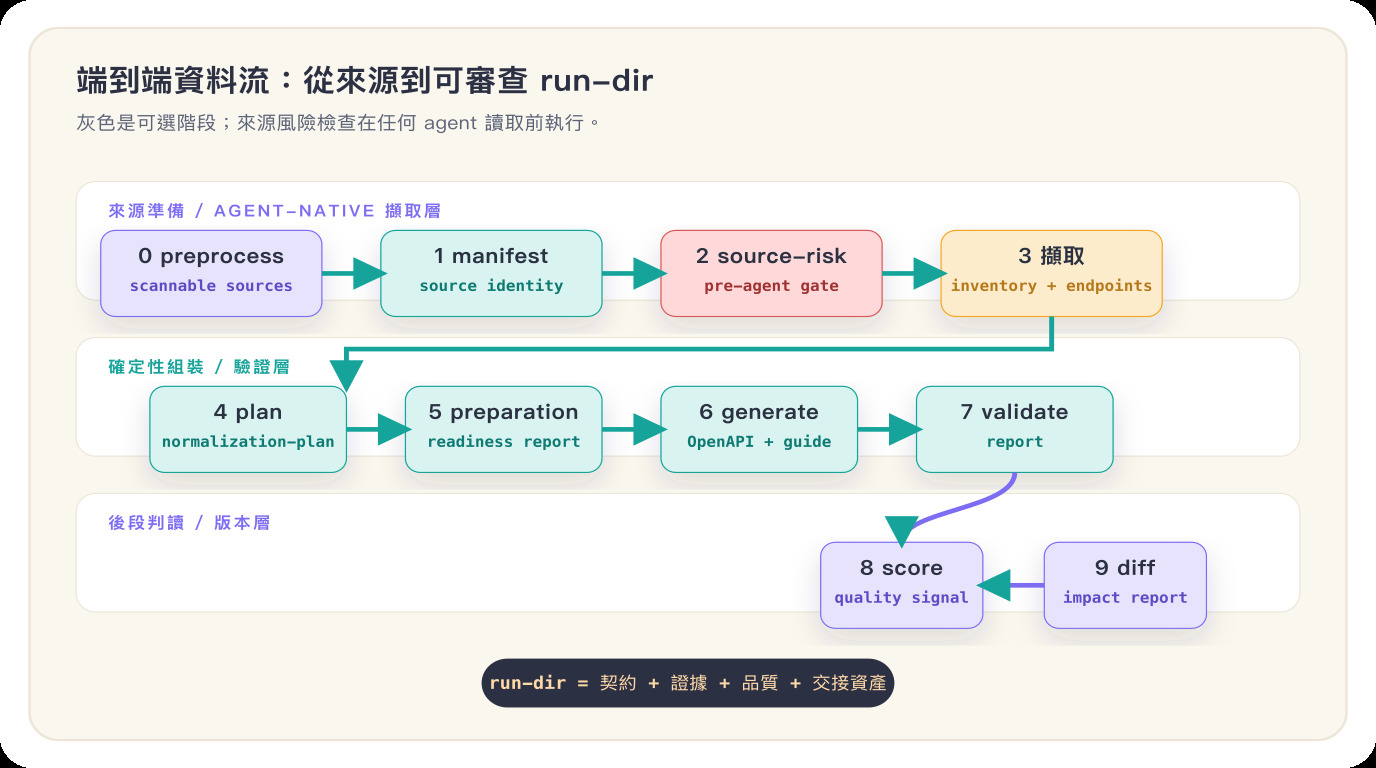
CLI commands, each with its own job
The CLI entry point is Typer (cli.py). Note: extraction is not in the CLI — that's the agent's job; the CLI handles the back half and tooling steps (source processing, URL evidence, source quality, run handling, asset governance, and local human review).
PDF/DOCX → markdown; DOCX also gets deterministic source-hash provenance and unsafe OOXML is rejected before output.
Scan local sources + URLs and build manifest.json.
Pin a single Swagger/OpenAPI JSON/YAML URL as an immutable local source and build a direct coverage ledger.
Download the entry page just once to build a sidebar navigation index (coverage universe); never auto-fetches child pages.
Select catalog nodes by explicit scope (branch/keyword) as reading starting points; downloads no URLs.
Cache all catalog pages and build local body/link/entity indexes (corpus.json); no model involved.
Directly cache a single entry page, for an empty catalog or a single-page document.
Normalize a static HTML snapshot into supported Markdown, keeping a URL/SHA-256 provenance sidecar.
Import protected browser-rendered HTML/Markdown as immutable local evidence plus versioned provenance and fetched_rendered coverage. A verified match lets manifest/assemble skip that origin probe; mismatches fail closed.
Import a hand-written excerpt of supplier correspondence as a supplementary source, with a provenance sidecar bound to its content (origin, receipt time, excerpter, SHA-256). It may fill missing but never supports explicit_support, and it stays out of the freshness fingerprint — the dividing line is re-obtainability. The excerpt is written by a person, so the sidecar buys accountability, not verifiability (ADR 0010).
Output candidate page cards from body links and shared entities; the model reads candidate page bodies only when needed.
Required before any agent reads sources. Scans manifest-bound Markdown, HTML, and OpenAPI JSON/YAML without rewriting sources or echoing matched payloads; raw PDF/Word are unscannable and must be converted first.
Exit codes: 0 pass · 1 reject · 2 invalid, stale, unsafe, or unreadable input.
Pre-extraction source quality gate: requires --source-risk, verifies its source/manifest binding, embeds the audit, and assesses traceable observations. A reject may return explicit, de-duplicated required_source_refs as a bounded next-capture list without crawling.
Check whether the agent-produced extraction JSON conforms to the assemble input contract; writes nothing, creates no run-dir. Optional v1 evidence[] references re-materialize, verify their digest, and resolve their claim path. The contract includes the source-fact inventory: when a source section plainly lists a parameter table or example blocks and the extraction left them empty, that is a silent omission rather than "the source does not say" — to claim the latter, name the field in missing.
Assemble the JSON the agent wrote → plan → preparation → generate → validate, reporting via --json; optional --score and --url-coverage, with required --source-quality. Assemble rebuilds the manifest and revalidates the embedded source-risk binding before creating a run-dir, refusing unaudited runs without claiming to prove off-process source-read chronology.
Exit codes: 0 validation PASS · 1 validation FAIL · 2 extraction input file error (leaves no orphan directory).
Re-run validation on an existing run-dir and produce a report (without regenerating).
Read an existing run-dir's OpenAPI, provenance, manifest, and validation report, and produce a quality score.
Exit codes: 0 pass · 1 needs_attention / fail · 2 run-dir input error.
Compare two runtime replay JSON files for one case version and write immutable quality, cost, and latency deltas; it never assembles, imports, or approves a contract.
The implementation-conformance group: assess (0 closed, 1 reviewable/open, 2 error), propose (0 proposal, 1 none, 2 error), submit (immutable candidate case stage), review (one write-once non-approval decision and corrective route, with or without a proposal), approve (separate immutable approved Effective release; independent human, required expiry, exact-scope publication), compose (non-publishing preview), current (exact-target Effective lookup requiring timezone-aware --at), and provider-erratum (non-mutating handoff into the full normative source pipeline). Current lookup rejects not-yet-effective or expired assets, a non-current normative base, and stale pointer/artifact digests, while exposing validity, open/untested, stale-amendment, and unresolved-contradiction counters. Same-target conflicts fail closed unless explicit same-scope supersession is recorded. Global Foundry current remains normative.
Turn a freshness-watchlist batch result into a bounded human-work trigger: changed sources become review_required, while unreadable or inconclusive sources become attention_required. Optional --snapshot-dir retains only the same-scan changed raw bytes as an immutable, content-addressed evidence pack; it never re-extracts, generates, imports to Foundry, or approves a contract.
Compare the version differences between two completed run-dirs.
Exit codes: 0 done · 2 input run-dir has a missing file or bad format (DiffInputError).
The project-local asset governance sub-group (init / import / approve / list / current): import a completed run as a candidate, approve it into a versioned asset, and maintain the current pointer.
A 127.0.0.1 workbench that auto-imports a candidate, compares current/baseline, and saves review/decision.json handoff. Only an explicit human approval updates current; it never calls a model or replaces validation.
Extraction is split into ten stages
Why stage it? To avoid a single answer carrying all the content and losing fidelity. The agent extracts step by step across these ten stages, converging into inventory.json and per-endpoint endpoints/*.json.
One run delivers the contract, the evidence, and the handoff assets
The core artifacts provide the API contract and source grounding; the derived artifacts provide quality reading, version comparison, and downstream engineering handoff.
Standard spec
openapi.yamlOpenAPI 3.1, ready for toolchains and engineers to consume directly without each interpreting the sources themselves.
Traditional Chinese integration guide
api-guide.zh-TW.mdA human-readable Traditional Chinese guide, so you don't have to slog through the original.
Source provenance
provenance.jsonEvery output states which source and which section it came from, so each can be cross-checked one by one.
Validation report
validation/reportLists gaps and conflicts, including supported sources with zero citations and successful responses with no usable schema fields.
Quality score
score/score.{json,md}Turns five quality categories into comparable scores and reports response fields, operations, and hollow operations.
Handoff pack
handoff/ · examples/A task list, Postman collection, SDK hints, and request examples to help the integrating engineer take over.
Manual review page
review.htmlA single-file HTML you can open offline, gathering scope, sources, API structure, and a specification-governance list onto one page for a quick human check. Gaps, source conflicts, and unverified facts remain trackable items; a document that omits a server URL, authentication details, or sandbox credentials does not by itself establish an integration risk.
No speculation, enforced by aligning targets one by one
This is the key mechanism by which "never guess" is machine-enforced: the target strings in provenance.json align one-to-one with OpenAPI locations.
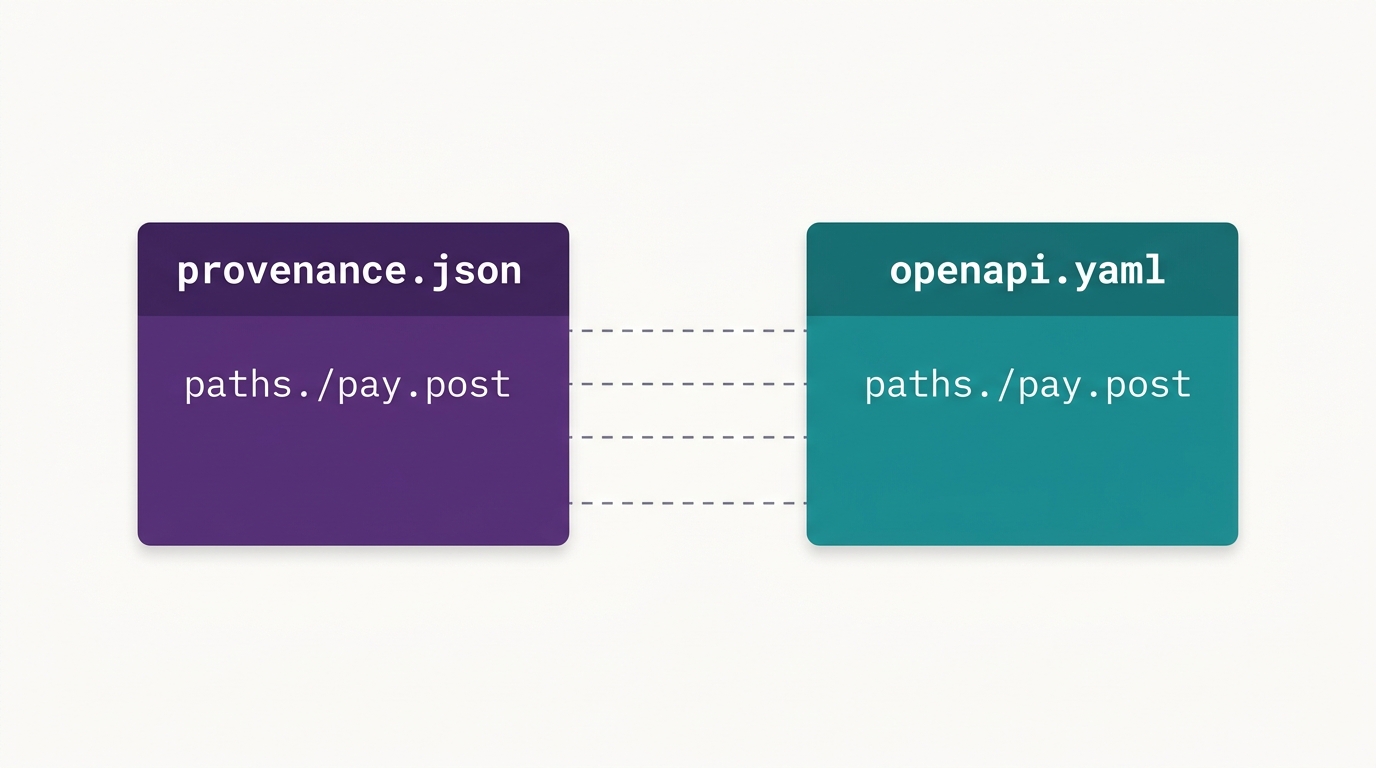
The no-speculation check cross-references exactly these targets: anything entering the output must trace back to a source-grounded plan item, or it counts as a violation. The aligned locations include paths.{path}.{method}, components.schemas.{name}, and components.securitySchemes.{name}.
Validation issues get classified, not blindly retried
There is no CLI built-in correction loop. assemble reports the classification result, and correction is driven by the agent itself: go back and re-read the sources, overwrite the corresponding JSON, and run again, for up to 3 rounds. Issues fall into two categories:
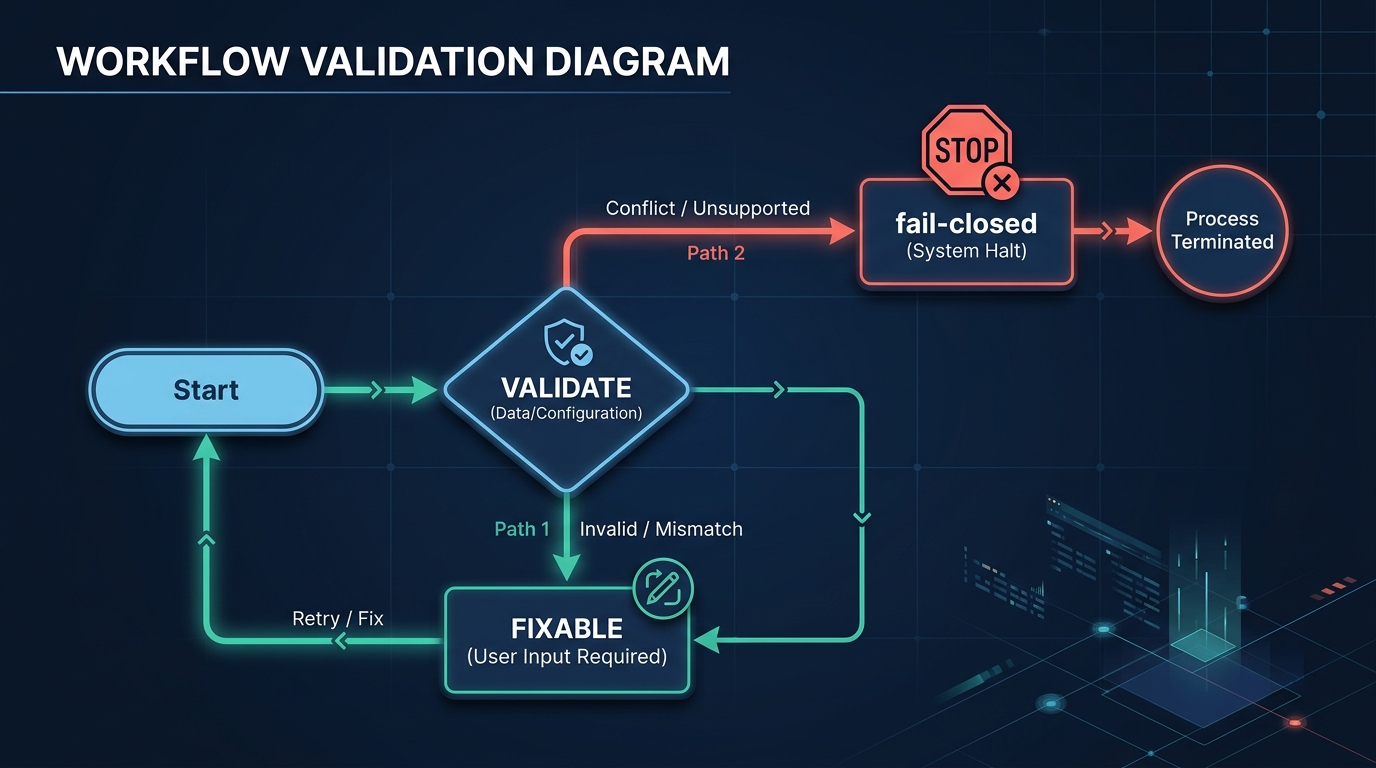
Fixable (FIXABLE)
The artifact itself is wrong → the agent corrects the JSON and regenerates.
Required information is missing → the agent goes back to re-read the affected source and fills in that piece.
Not fixable (fail-closed)
The source can't be confirmed / sources conflict / an unsupported assertion → do not fill it in; report it faithfully as a gap or conflict. This is exactly where the core invariant is enforced.
The benchmark has four layers; SKIP is not PASS
New engineers can easily conflate "the fixture is committed," "the test discovered the case," and "the source-backed assertions ran." The harness deliberately separates four layers; see docs/BENCHMARK_VALIDATION_PLAN.md for the full contract and case-addition workflow.
1 · Committed inventory
fixture identityA case contains both extraction/inventory.json and expected/validation.expect.json; there are currently 13 unique cases.
2 · Discovery guard
CI-safeEven without local source snapshots, CI confirms that every fixture is discoverable and exactly matches the required inventory.
3 · Source-backed execution
original sources requiredAssemble and artifact assertions run only when the original, dated sources/ snapshot exists; a missing source produces SKIP.
4 · Strict-local preflight
all sources · zero skipsEvery required case must have non-empty sources, every source-backed check must execute, and the run must report zero skips.
benchmarks/<case>/sources/ contains operator-provided, gitignored snapshots. CI can prove committed inventory, discovery, and deterministic parity, but it cannot call a missing-source SKIP a pass. Never replace an unavailable historical snapshot with newer documentation, synthetic data, or an error page.
scripts/quality_gate.py --sanitized-fixtures replays reviewed, line-preserving exact-evidence fragments in CI. The current pilot is rsg-game-transfer-wallet. This lane sits outside the four layers and proves fixture-backed parity only for retained claims; it neither replaces original sources/ nor qualifies as source-backed or strict-local PASS.
On version change, classify by downstream impact into four buckets
diff compares the old and new completed run-dirs of the same API, looking at "will this revision break downstream integrations" rather than "which words in the source changed." Each difference is assigned to one of the four impacts below and sorted by severity from high to low, so you can see at a glance whether to block it and whom to notify.
Breaking breaking
Could break existing integrations outright; highest risk.
For example: removing an endpoint (operation removed), making an existing field/parameter required (became required), adding a required parameter, dropping a response or security scheme, or a schema structure change.
→ Block before release; proactively notify all integrators to adjust.
Additive additive
Purely adds things, usually backward-compatible.
For example: adding an endpoint (operation added), adding an optional parameter/field, adding a response or media type, or adding a schema / security scheme.
→ Safe to adopt; downstream decides for itself whether to use the new features.
Changed changed
Existing content changed, but not necessarily breaking compatibility.
For example: a parameter/field's description text changed (description changed), a servers address updated, info version metadata updated, or an unreferenced schema in components removed.
→ Read what changed and confirm there's no hidden impact on your side.
Source only source_only
The source or metadata moved, but the final API contract didn't change.
For example: the source file itself changed (manifest source changed), provenance tracing adjusted, or validation / preparation report contents changed, but the OpenAPI spec itself is unaffected.
→ Rest easy, the spec is unchanged; if you care, go back and see why the source moved.
Comparison scope: OpenAPI paths · methods · parameters · schemas · security · webhooks, integration-contract, provenance, the validation summary, and manifest (the first version does not compare the Markdown guide or examples). Output is written to diff/report.{json,md}; exit code 0 done, 2 means the input run-dir has a missing file or bad format (DiffInputError).
How the code is split into packages
Principle: apart from a few I/O exits, all other modules are pure functions, which makes them easy to unit-test. When making changes, hold this boundary so every loop can be verified independently.
| Package | Responsibility |
|---|---|
manifest/ | Scan local sources + build manifest.json; each source's authority (normative by default, or supplementary) is declared by its same-named .source.json sidecar, and the read side fails closed |
rendered_url.py | Offline rendered-source import plus read-side provenance verification; writes immutable source/sidecar/coverage and prevents a matched protected-origin probe |
url_safety.py | The egress gate: safe_client() validates the caller's URL and every redirect hop from an httpx request event hook, so a fetcher cannot forget to check and a 302 cannot jump into a private address. The criterion is HTTP(S) scheme, no userinfo, and every resolved address globally routable (every, not any — a name resolving to one public and one private address is the standard bypass); trust_env=False so a proxy environment variable cannot route around it either. The same module owns the write side: RedactedUrl is an annotated type whose serializer replaces credential values in a URL with [REDACTED] before it reaches disk (corpus.json, coverage.json, provenance sidecars, CLI stdout); in memory the URL stays whole, because a fetcher reads it off the model before issuing the request. Which field names count as credentials is privacy.py's is_credential_key to decide, not this module's. catalog.json is the one exception and keeps whole URLs — cache-url-pages reads it back and fetches from it, so a URL there is an instruction, not evidence (ADR 0015). |
supplementary_note.py | Imports a hand-written excerpt of supplier correspondence as a supplementary source; writes the immutable source plus a provenance sidecar bound to its content |
agentcli/ | assemble.py (assemble JSON → plan→preparation→generate→validate), input_schema.py (pydantic validation at the boundary), evidence.py (read-side v1 exact-evidence materialization/digest and claim-path verification), gate.py/verify.py (the extraction-contract check for verify-extraction, including the source-fact and deferral gates from source_facts/, writes nothing), extraction.py (inventory → plan answers), preprocess.py (typed PDF/DOCX→markdown orchestration) |
docx_*.py | docx_normalization.py is the stable facade; package-wide fail-closed OOXML validation/rendering stays pure, while docx_publish.py owns staged provenance publication with rollback on reported write failures |
shadow/ | Opt-in legacy/Core bridge and in-memory runner; only shadow/report.py writes the observational core/ artifact set or a safe error report. |
core/conformance.py + domain/conformance.py | Pure ContractConformance assess/propose/compose boundary plus immutable authority, observation, amendment, and Effective Contract models. |
feedback/ | Normalized-JSON loading, full-Normative-release digest-bound assessment/proposal/composition, governed workflow adapters, timezone-aware exact-target lookup, and Provider Erratum handoff. Current lookup rejects not-yet-effective or expired assets and stale base/pointer/artifact bindings, and exposes bounded validity/discrepancy counters. Dry-run outputs stay outside .foundry; submit/review/approve persistence is delegated to Foundry and no command performs provider network I/O. |
extraction/ | Shared models + utilities (stages / questions / store / jsonblock) |
plan/ | Normalization plan + source-match classification |
preparation/ | Pre-generation readiness assessment + preparation-report (report.py writes files) |
generate/ | Generate OpenAPI / Markdown / review.html / provenance / examples / handoff (writes files) |
validate/ | Structure / completeness / consistency / no-speculation checks + report |
run/ | run-id generation, result/status models, writing the plan into the run-dir (writes files) |
score/ | Read a completed run-dir and produce score/score.{json,md} with five weighted categories (report.py writes files) |
diff/ | loader.py / compare.py / models.py / report.py (report.py writes files) |
freshness/ | A cheap scheduled freshness gate: record.py writes a baseline fingerprint from a completed run-dir (sha256 for local sources, one version signal per URL source, supplementary carriers always excluded — they cannot be re-obtained, so including one would only report fresh forever; a run with nothing re-obtainable is refused outright, and overwriting still needs --force), signals.py recomputes and classifies the current signal (network reads, writes nothing), check.py aggregates one docset, batch.py fans the gate across a watchlist (a per-item error is captured in that item's result rather than aborting the batch), report.py writes the reports. The exit codes are the contract: 0 unchanged, 1 changed, 2 inconclusive |
source_risk/ | Manifest-bound pre-agent text inspection and verified audit loading, covering both directions — whether a source can manipulate the agent and whether it leaks material to it. Among the leak rules only self-evidencing material (PEM private-key blocks, JWTs) blocks; a credential reference stays a warning, because a competent document documents its own Authorization header. reads exact source bytes and writes source-risk-report.{json,zh-TW.md} without rewriting or echoing source payloads |
source_quality/ | Pre-extraction source quality assessment and source version diff report; requires and embeds a verified source-risk audit; rejected reports may expose explicit bounded required_source_refs without crawling (writes files) |
focus/ | Requester-authored extraction focus directives: models.py (the strict contract; kind determines severity, intent determines anchor type, and there are only two outcomes, satisfied / not_found), loader.py (reads focus.json and focus-response.json — this package's only file-reading exit), gate.py/fields.py/codes.py (pure checks: one answer per directive, anchor resolution, and a not_found that must account for every readable source), report.py (writes <run-dir>/focus/, the only file-writing exit). A falsified assertion travels through the ValidationReport as FOCUS_UNMET rather than through the input gate — that is what keeps the artifacts available for a human to judge. A collect_error_codes answer reporting fewer codes than the documented floor computed from the source tables travels the same route, becoming a FOCUS_INCOMPLETE that names the omitted codes and where they are documented |
source_facts/ | Source-fact inventory: markdown.py mechanically scans Markdown sources for endpoint declarations, parameter tables and example blocks; collect.py reads the manifest-named sources (this package's only file-reading exit); gate.py compares them against the extraction JSON (resolving schema_ref into inventory.schemas transitively, so a shared body type is deduplication rather than an omission) and deferral.py rejects placeholder answers |
gitbook_llms.py / markdown_drafts/ / extraction_scaffold/ | Deterministic GitBook acquisition fetches one llms.txt, safely caches every in-scope Markdown page plus provenance/coverage, then scans manifest-named Markdown into non-authoritative line-cited endpoint/table/example drafts and can project them into extraction-shaped scaffolds. A scaffold must be copied, reviewed, and completed in the work directory; it never replaces source_facts/, final extraction, or serves directly as --extraction. |
url_catalog.py / url_corpus.py | Bounded URL navigation index, page caching, and related candidates, letting the agent read web docs from local evidence (writes files) |
foundry/ | Project-local asset governance: normative assets stay immutable, with supersession recorded on the new asset before pointers advance. Feedback inputs form the write-once candidate stage; bound decision/amendment records are append-only, and approval creates a separate immutable Effective release. Global current remains normative; Effective selection is exact-scope, time-aware, digest-verified, and rejected before approval/composition, after expiry, or after normative-base supersession. |
review/ | Local single-user workbench: auto-import a candidate, compare current/baseline, persist structured handoff, and update current through Foundry only after explicit human approval (writes files) |
UrlSource.fetch_url is for issuing the request; its redacted form, citation_id, is for naming, comparing, and writing down. Reading the wrong one either puts a credential into plan.json or silently breaks a comparison/join — because a value read back from disk is redacted while its counterpart in memory is not. tests/test_citation_identity_contract.py fails on any read of fetch_url outside its ALLOWED list. Marked rows contain file I/O exits: generate/, run/, agentcli/preprocess.py, shadow/report.py, feedback/report.py, preparation/report.py, score/report.py, diff/report.py, source_risk/report.py, source_quality/, freshness/, docx_publish.py, rendered URL import, supplementary_note.py, the URL corpus cache, foundry/, and review/workflow.py writing through Foundry. feedback/loader.py, docx_normalization.py, source_risk/inspect.py, and adapters/fragments.py are read-side I/O exits; Core and Domain remain pure.
Glossary · What to read next
Glossary
- seam
- The only boundary between the two stages (inventory.json + endpoints/*.json), and also the cut point for testing.
- manifest
- The source inventory file, recording which sources and URLs were scanned.
- normalization-plan
- The plan after normalizing the extraction results; the shared input for generate and validate.
- provenance
- Source provenance; target aligns one-to-one with OpenAPI locations.
- preparation
- Pre-generation readiness assessment; in the quality loop, it flags blockers and things to watch first.
- score
- The quality score of a completed run-dir, used for back-half reading in the CI or review profile.
- handoff
- The engineering handoff pack derived from OpenAPI and the integration-contract; not a new contract source.
- Normative / Effective Contract
- The approved supplier-source release (contract + documentary fragments + support relationships) versus its deterministic, exact-scope composition with applicable approved amendments; they are distinct digest-bound artifacts and authority views.
- Applicability Envelope
- The complete provider, deployment, environment, identity, configuration, client, test-data, and time boundary for interpreting one observation or amendment.
- fail-closed
- When something can't be confirmed / conflicts, choose "don't output" rather than "guess one."
- run-dir
- The output directory of a single run, holding all of that run's artifacts.
What to read next
- Run it once — install per
README.md(uv sync) and walk through with a sample frombenchmarks/. - Architecture details —
docs/ARCHITECTURE.md: the seam, package map, data flow tables. - Extraction behavior —
skills/loop-apidoc/SKILL.md: how the agent actually reads sources and stages the work. - Design basis — the enduring product decisions in
docs/DESIGN_DECISIONS.md.